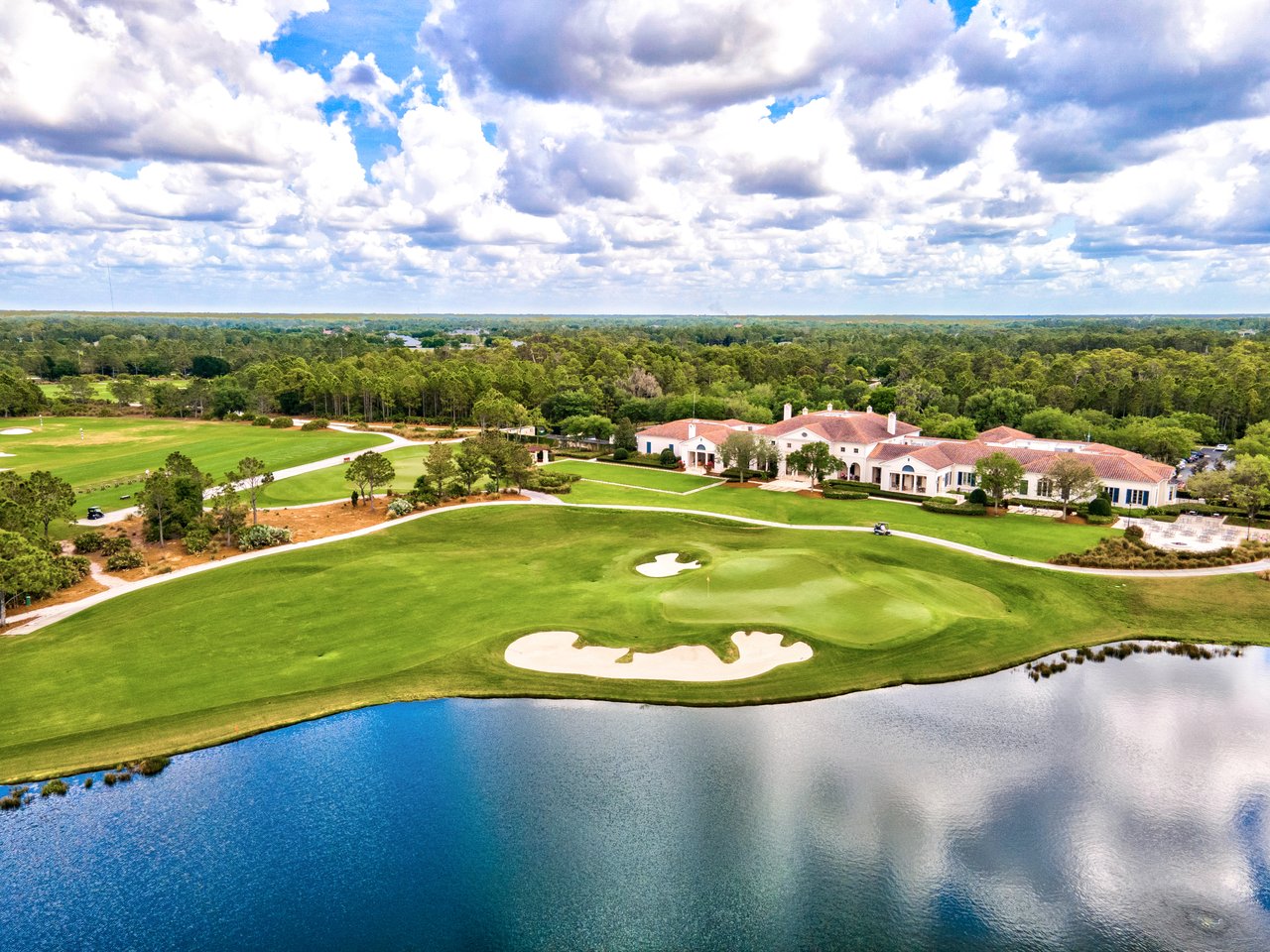
A drone shot of the Commander Course sells the photograph. The assessment schedule sells the house. In Lakewood National, those are two different documents, and the seller who treats them as interchangeable is often the one watching a full-price offer wobble the week the buyer's lender orders the estoppel letter.
Here is the mechanism at the center of it. Golf membership at Lakewood National is not an amenity a buyer opts into after closing. It is deeded to the property, transfers automatically at the sale, and cannot be declined. Every household that owns a home here pays for golf access whether anyone in the family swings a club or not. That single structural fact, more than square footage or lanai orientation, determines who your buyer actually is and what number they compare your listing against.
Most sellers already know the community has golf. Fewer understand that the mandatory model changes the math on both sides of the negotiation, and fewer still have pulled the exact current figure for their specific home type before putting a sign in the yard.
What "mandatory" actually costs
The golf side of the ledger is fixed and public. Annual golf dues run $3,960, with a separate $1,505 stewardship fee covering environmental upkeep and landscape enhancements beyond standard common-area maintenance. Together that is $5,465 a year, or roughly $455 a month, for unlimited access to both 18-hole Arnold Palmer-designed courses, the Commander and the Piper, cart included, no per-round green fees.
Layered on top are the community's separate HOA dues, which run $232 to $500 a month depending on home type, and a CDD assessment of $167 to $250 a month that funds roads, stormwater management and street lighting through the county infrastructure district. Add it up across a full year and Lakewood National's published 2026 assessment schedule lists total annual assessments ranging from $8,693.41 to $11,025.65 depending on the specific home type.
That range matters more than the average. Two houses on the same street, similar in size and finish level, can carry meaningfully different annual assessments once you account for lot type, model, and which fee tier applies. A seller who quotes the "typical" number instead of the number tied to their actual property is setting up a mismatch that surfaces at the worst possible moment: underwriting.
The comparison a buyer is actually making
Buyers shopping golf-adjacent real estate in Lakewood Ranch rarely compare Lakewood National to a random village across town. They compare it to the other bundled-golf communities they have also toured, and the numbers tell a story worth using in your listing conversation.
Community | Membership model | Initiation cost | Annual golf dues |
|---|---|---|---|
Lakewood National | Mandatory, deeded with home | None | $3,960 |
Esplanade Golf & Country Club | Bundled, no equity buy-in | None | $6,839 |
Calusa Country Club | Bundled, no equity buy-in | None | $6,839 |
Lakewood Ranch Golf & Country Club | Optional, non-equity | Reported at $95,000 to $110,000 across recent membership packets | Roughly $16,320 |
Lakewood National carries 36 holes across two Arnold Palmer courses, more than either Esplanade's 18 or Calusa's 30, yet its annual dues sit lowest among the three bundled communities. For a golfer playing weekly, roughly 52 rounds a year, that $3,960 figure works out to about $105 a round, in line with peak-season public course rates. That is a genuinely different value story than a golfer will hear anywhere else in the Ranch, and it belongs in your listing remarks, not buried in the HOA disclosure.
The traditional club comparison cuts the other direction. Buyers who have shopped equity or semi-private clubs elsewhere are used to writing a separate six-figure check, often $50,000 to $200,000, on top of the home price just to unlock membership. Lakewood National eliminates that check entirely. The membership rides with the deed. For a buyer weighing that alternative, the absence of an initiation fee is not a footnote. It is the headline.
The seller's job is not to decide whether golf belongs in the listing. It already does. The job is knowing which buyer wants to pay for it and pricing against the right comparable set instead of the community average.
Who the mandatory structure filters out
Because dues apply regardless of play, a strict non-golfer comparing Lakewood National to a non-golf Lakewood Ranch village could save $400 to $500 a month by buying elsewhere. That is real money over a mortgage term, and it is the honest reason some buyers who love the house still walk. Pretending otherwise in a showing does not serve the seller. Naming it up front, and pairing it with the per-round math for anyone who does play, does.
The same mandatory structure works in a seller's favor with a different buyer entirely. Lakewood National permits leasing up to twelve times a year, a detail that matters to second-home owners and investor buyers weighing seasonal rental income against carrying costs. A buyer running the numbers on a rental strategy is comparing net return, not just sticker price, and a fixed, deeded golf amenity with no waitlist and no separate buy-in is a selling point in that math, not a cost to explain away.
Before you list, get the number in writing
Public sources describing Lakewood National's costs do not always agree with each other, and that is itself the point for a seller. One published estimate lists total monthly costs near $1,000 to $1,200. Add up the component fees from the current schedule, HOA, CDD, golf dues and stewardship, and depending on home type you can land anywhere in that neighborhood or outside it. The community average is not your number. Your number lives on the current assessment letter for your specific address.
A few steps worth taking before the first showing:
- Request the current-year assessment figure for your exact home type in writing from the HOA, not a rounded community average.
- Put the total carrying cost, golf dues, stewardship, HOA and CDD, in the listing remarks rather than the HOA line alone, so a buyer's lender sees the same number twice and never once as a surprise.
- Price against Esplanade and Calusa as the relevant bundled-golf comparables, not against the broader Lakewood Ranch median, since your buyer is already shopping that shortlist.
- If marketing to an investor or second-home buyer, lead with the twelve-lease-per-year allowance rather than leaving it for the buyer's agent to discover in the documents.
The clubhouse anchoring all of this, a 28,000-square-foot facility with two dining rooms, a bar and grill area and a gas fireplace, was completed in August 2023 by Heatherwood Construction Company for Lennar Homes, under project manager Jeff Schurrer and superintendent John Tiseo. It is a fixed asset every buyer is underwriting into their monthly number whether they mention it or not. A seller who can speak to that structure with precision, rather than gesture at "resort-style amenities," is the one who controls the pricing conversation instead of reacting to it.
A few questions sellers ask first
Does the golf membership transfer automatically when I sell? Yes. The membership is deeded to the home, so it passes to the buyer at closing without a separate application or initiation payment.
Can a buyer opt out of the golf dues to lower their monthly cost? No. The membership and its associated dues are mandatory for all Lakewood National homeowners, which is why the total carrying cost belongs in the listing conversation from the start rather than a late disclosure.
Does the mandatory assessment affect financing or appraisal? It can, if the buyer's lender encounters the figure for the first time during underwriting instead of seeing it reflected in the listing and offer discussions. Sellers who provide the current written assessment figure up front tend to avoid that friction entirely.
Lakewood National rewards sellers who treat the fee structure as part of the pitch rather than a disclosure to get through. Knowing the exact number for your home, the right comparable communities, and the buyer segment most likely to see the value in what you are already paying for is what separates a listing that moves from one that sits.
If you are weighing a sale in Lakewood National and want a second set of eyes on where your specific home falls in that assessment range, Polachek Properties can walk through the current figures with you and help position the listing around them. Schedule a Consultation to get started.